Business systems architecture & implementation

Strategy, made operational.

Operant designs and implements the business systems that make execution dependable — across process, platforms, automation, people, and performance.

Architecture first. Configuration second. Adoption always.

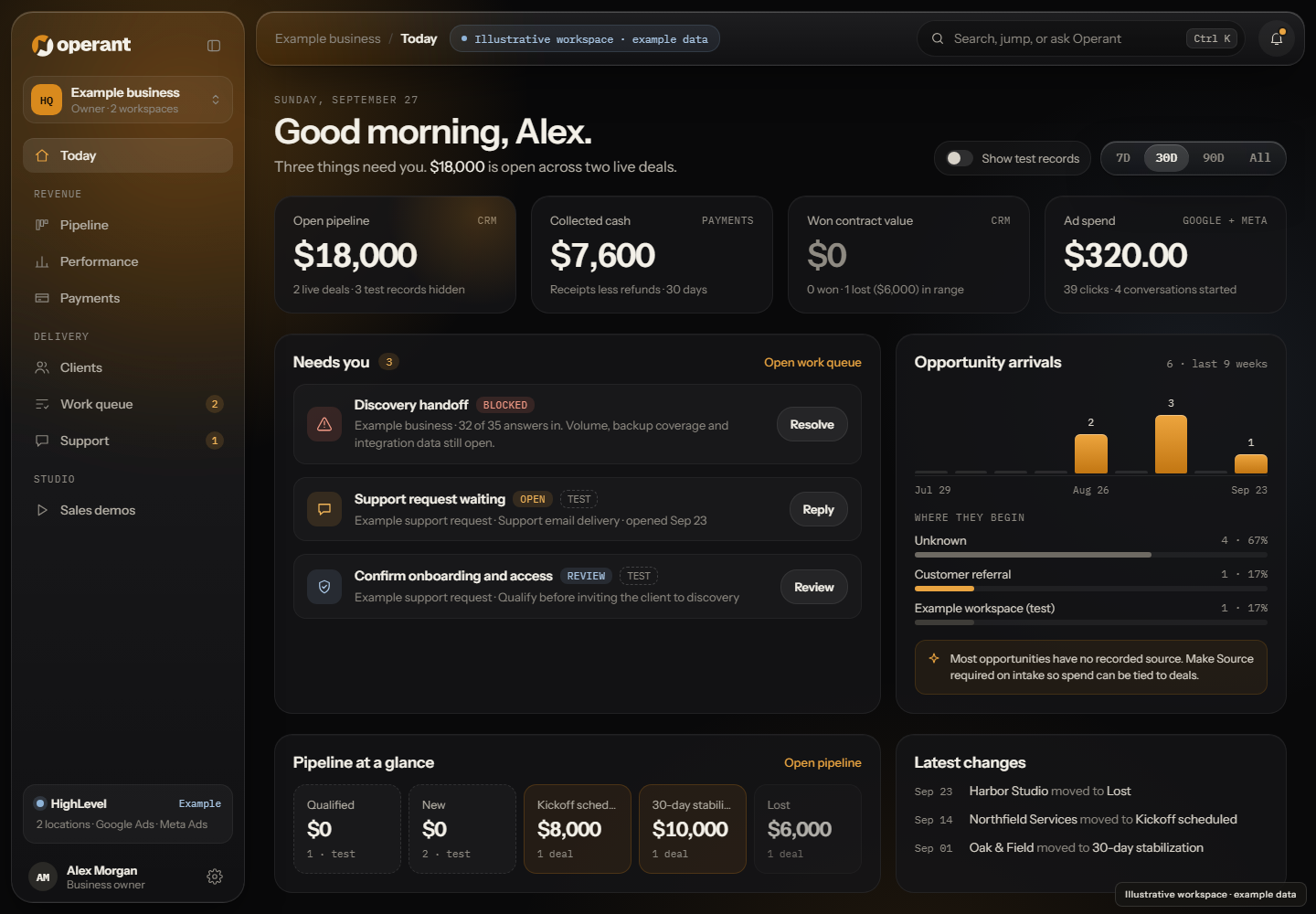
Operating truth
01 Architect
02 Integrate
03 Automate
04 Govern
05 Enable
06 Measure
The operating problem

Growth exposes every weak handoff.

When process lives in memory, tools hold conflicting answers, and teams build their own workarounds, growth creates more friction than momentum. Operant replaces that fragmentation with one designed operating truth.

01 / MEMORY

Critical work depends on people remembering.

Ownership is implied, next actions are inconsistent, and important follow-up disappears between systems.

02 / FRAGMENTATION

Every tool tells a different version of the business.

Teams maintain separate records, duplicate work, and spend leadership time reconciling status instead of acting on it.

03 / VISIBILITY

Leadership has to ask for the truth.

Performance, bottlenecks, and ownership stay hidden until someone manually assembles the answer.

Precision machinery arranged as a connected operating system
CONNECTED DELIVERYOne operating truth across every team.
Operator working within a structured technical environment
OPERATING DISCIPLINEExecution should not depend on memory.
The Operant model

One system. Six connected movements.

Each movement solves a different failure point. Together they create the infrastructure required for dependable execution.

01 / ARCHITECT

Define the operating model.

Map ownership, handoffs, data, decisions, roles, and the target flow before software is configured.

02 / INTEGRATE

Connect the operating stack.

Make platforms, teams, records, and communication work from a coherent source of truth.

03 / AUTOMATE

Remove avoidable manual work.

Automate repeatable triggers and routing without obscuring accountability or exception handling.

04 / GOVERN

Control how the system stays true.

Establish permissions, standards, ownership rules, change control, and operating discipline.

05 / ENABLE

Make the system usable.

Train by role, document the process, and build adoption into the launch rather than hoping it happens.

06 / MEASURE

Make performance visible.

Expose bottlenecks, ownership, conversion, status, and next actions so the system can keep improving.

Capabilities

From blueprint to operating reality.

Operant stays through design, implementation, adoption, and refinement. The deliverable is not a software login; it is a business that can reliably move information, ownership, work, and outcomes.

Operating Blueprint

Current-state diagnosis, friction mapping, target operating model, platform responsibilities, and implementation roadmap.

  • Discovery
  • Process mapping
  • System design
  • Roadmap

View the blueprint

CRM & platform implementation

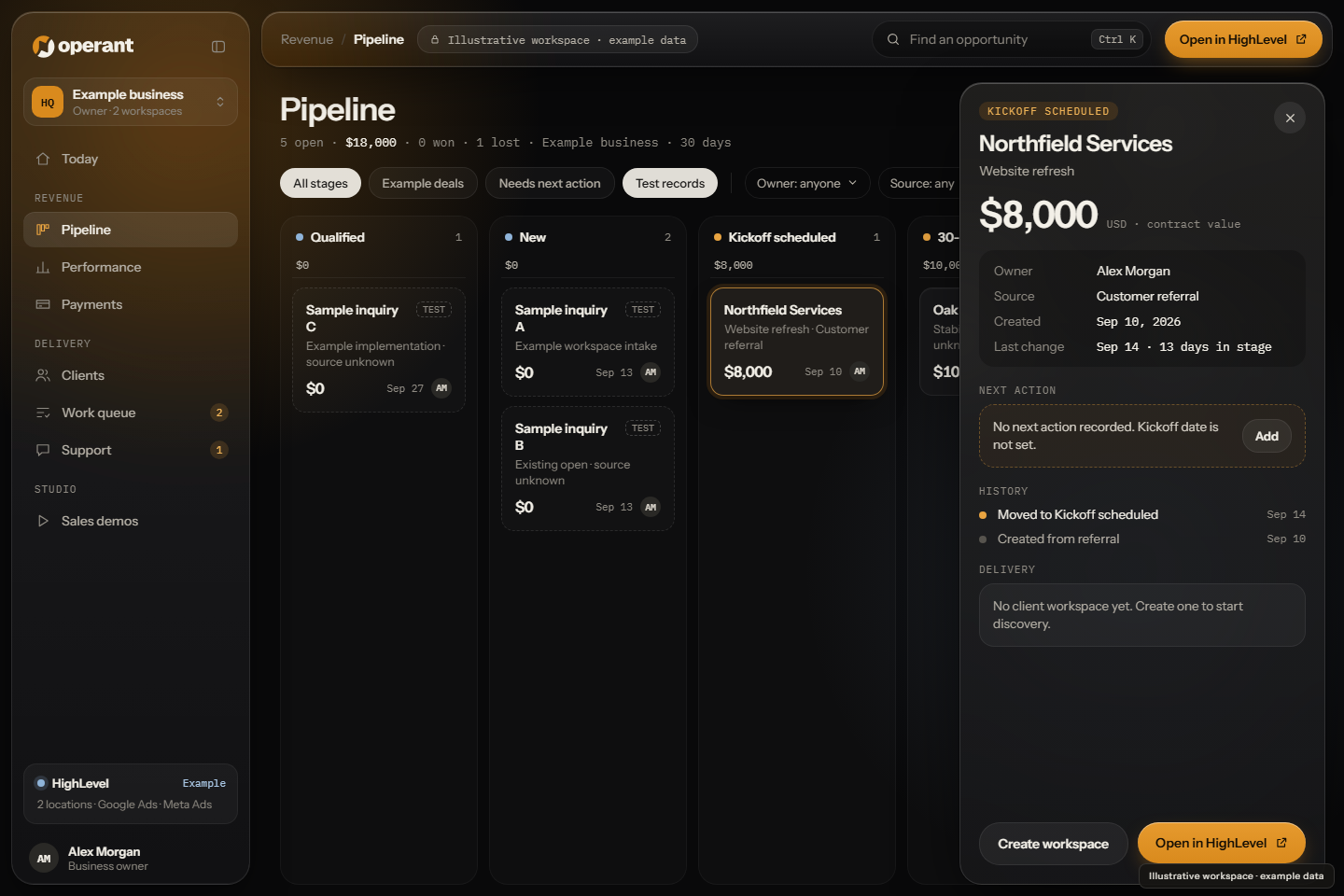
Selection, configuration, migration, integrations, testing, documentation, launch, and stabilization around the actual operating model.

  • CRM
  • Data model
  • Permissions
  • Launch

Explore implementation

Automation & AI enablement

Practical automation and AI applied where it improves speed, consistency, response, analysis, or knowledge access.

  • Workflow automation
  • AI agents
  • Routing
  • Knowledge

Explore automation & AI

Adoption, governance & optimization

Role-level enablement, SOPs, accountability, system stewardship, reporting review, and controlled evolution after launch.

  • Training
  • SOPs
  • Governance
  • Optimization

Explore governance

Most CRM problems are not CRM problems. They are ownership, process, or definition problems moved into software too early.

Architecture first. Configuration second.

Delivery

Design it. Build it. Make it stick.

Operant moves from diagnosis to implementation in a controlled sequence so software supports the business instead of becoming another layer of ambiguity.

01

Discover

Understand the business, the customer journey, the internal handoffs, the bottlenecks, the reporting needs, and the current technology.

02

Design

Build the Operating Blueprint: target workflows, ownership, permissions, records, platforms, dashboards, automations, and change plan.

03

Implement

Configure the systems, connect the stack, migrate the right data, test the flows, and prepare the environment for launch.

04

Enable

Create the operating documentation, train people by role, define ownership, and make the new process the expected way of working.

05

Optimize

Measure actual use, fix friction, refine workflows, improve reporting, and evolve the operating system as the business changes.

Platform philosophy

Use the system that fits the operation.

Operant is platform-agnostic. If the current CRM fits, improve it. If it does not, define the requirements and select the right one. Familiarity is not a strategy.

CRM & RevOpsProject & work managementCommunicationWeb & conversion infrastructureAutomation & AIReporting & attributionData & integrationsGovernance & enablement
Partner ecosystem

Independent expertise. Connected delivery.

Operant can work directly or as the systems architecture and implementation layer inside a coordinated partner engagement.

Live partner

Refined Media Group

Media capability and demand generation connected to the systems layer that captures, routes, measures, and operationalizes the response.

Visit Refined Media
Partner site in progress

Refined Agency

A broader coordinated agency model connecting strategy and specialist execution. This local page is the safe placeholder until the final Refined Agency domain is live.

View partner overview
Questions

What businesses usually ask first.

The short answers below explain the category. Real scope starts with the operating problem, not a preselected software package.

What does Operant actually do?

Operant designs and implements the operating systems behind a growing business: workflows, CRM, data, automation, integrations, reporting, permissions, governance, training, launch, and ongoing refinement.

Is Operant a CRM company?

CRM is one part of the work, not the category. Operant starts with the operating model, then selects, improves, or configures the platforms that best support it.

Do you only work in GoHighLevel or Salesforce?

No. Operant is platform-agnostic. Existing systems are improved when they fit; new systems are selected against the actual process, governance, reporting, and integration requirements.

Where does AI fit?

AI is applied to repeatable work, decision support, communication, and knowledge access when the process is defined and human ownership remains clear. It is not used to hide an undefined process.

What is an Operating Blueprint?

It is the diagnostic and design engagement that maps the current operation, isolates structural friction, defines the target operating model, and produces a practical implementation roadmap.

Operating Blueprint

Build the system before scale makes the decision for you.

Start by mapping the operation, isolating structural friction, and defining the implementation path.